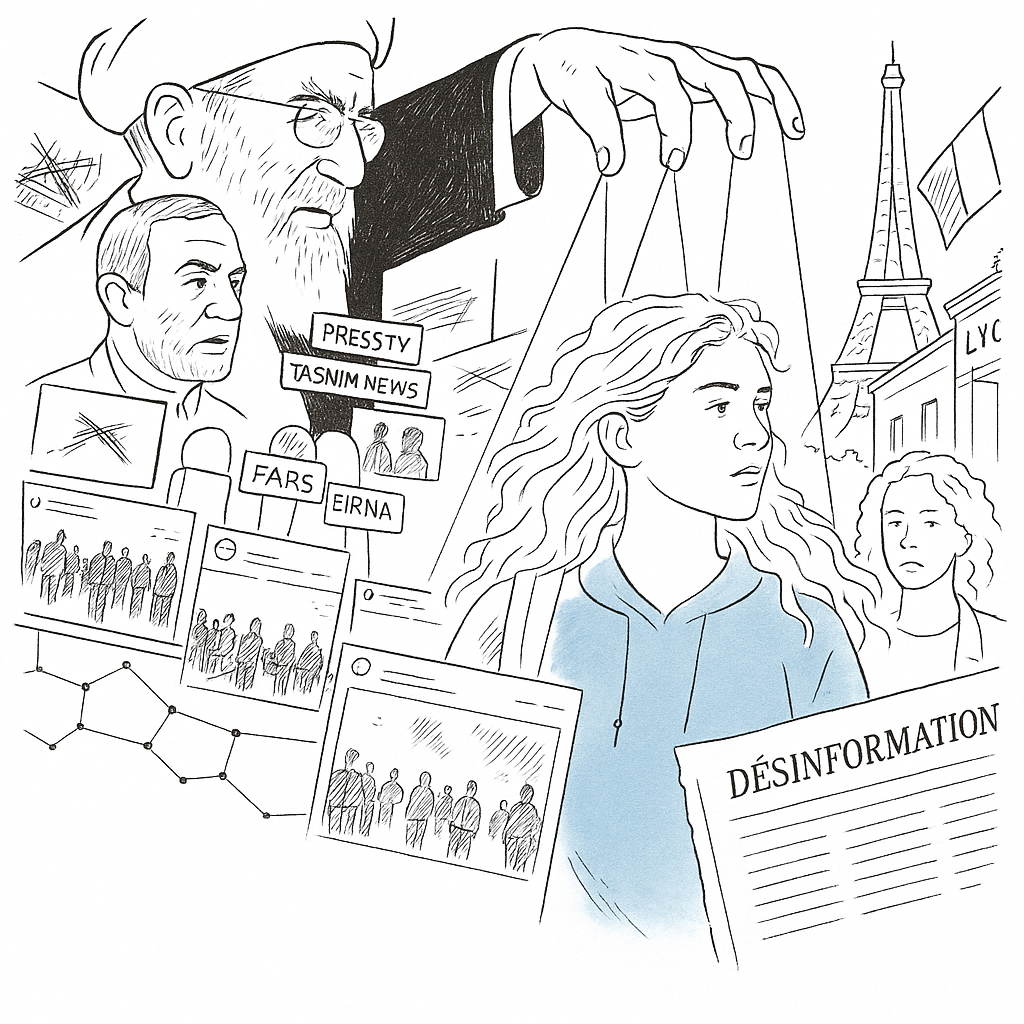
On 19 October 2026, the foreign minister of a regime that killed thousands of its own citizens in January told the French president to “listen to the future of France”. Abbas Araghchi wrote that “the French people demand wholesale change, including freedom of assembly”. This is no longer commentary on a foreign crisis. It is a government ruling on France’s political future, at the end of a three-week campaign that the French Foreign Ministry had already called a “disinformation campaign” when it summoned the Islamic Republic’s ambassador on 7 October. In less than a month, the Islamic Republic moved from its Revolutionary Guards outlets to a spokesman writing in French, then to its chief diplomat. DORNA reads this escalation as a deliberate test of how far the Islamic Republic can go in France without paying a price. The answer should come at the same level.
A state campaign, run in the open
Iran Observatory’s dossier reconstructs the campaign day by day, from its first message on 28 September to the minister’s post of 19 October.
The senders leave no doubt about who is speaking. They are the foreign ministry and its spokesman Esmaeil Baghaei; a member of parliament, Mojtaba Zarei; the agencies Tasnim and Fars, tied to the Revolutionary Guards; the Guards’ daily Javan; Kayhan; and state broadcasting with its foreign services, Press TV and HispanTV. This is no network of anonymous accounts that one can attribute only with caution. It is a state speaking through its own institutions.
The sequence is telling. On 28 September, a week after the movement began at a lycée in Créteil, Tasnim’s Telegram channel announced a school set on fire by its own pupils. Until 1 October, the same channels showed French teenagers as rioters. On 2 October, Baghaei fixed the official line: French pupils had become victims of repression, and the institutional media followed. On 6 October, the Iranian regime summoned the French ambassador and demanded an “independent investigation mechanism” into the French police. On 10 October, a rally was staged outside the French embassy in Tehran with placards written in French, and an MP offered the French police the “experience” of the student Basij. The narrative changed with the political instruction, not with the facts.
The demand for an independent mechanism deserves attention. It is the very wording of the UN resolutions that target the Islamic Republic, and the Islamic Republic has never accepted such a mechanism on its own soil. A government that refuses independent scrutiny of its own crackdown now claims to require it of a democracy whose courts are already at work.
Falsehoods, checked one by one
Iran Observatory examined eight claims made by the regime’s officials and media. Five are false or baseless, two distort a real fact, one is accurate.
- An internet shutdown in France. Kayhan ran “the Macron government has cut the internet” and Javan compared “internet shutdowns in France and Iran”. No state-ordered shutdown took place. One pro-regime channel even cited, in the same message, outage reports from French operators.
- “7,000 pupils and students in prison”. The French Ministry of Justice counted 6,877 people taken into police custody by 8 October, 86% of them minors, and 21 placed in pre-trial detention. Custody is not prison, and the gap is not a detail.
- “France’s javid-nam”. An image of body bags lined up in a Paris street, matching no documented event in France, first appeared on 5 October on a pro-regime X account with about 7,700 followers, then under the logo of a Telegram channel followed by a million people. No death has been reported in the movement.
- A demand to leave NATO and the EU. An infographic attributed this to French pupils, whose actual demands concern unfilled teaching posts, overcrowded classes and school buildings. Fars presented a “Frexit” march filmed by RT as the streets of Paris rising against Macron, on the very day it quoted the pupils’ real demands from Reuters.
- The UN ordering France to stop. The UN human rights office called on everyone to keep protests peaceful and asked that law enforcement avoid disproportionate force. HispanTV and Kayhan kept only the second half.
- Macron “welcomes atrocities against Iranians”. Araghchi’s own post reproduces the message Macron sent to Donald Trump, made public on 19 January 2026: “We can do great things on Iran.” It mentions neither atrocities nor Iranian victims.
The campaign rests on real incidents. A 14-year-old pupil was hit in the face by a less-lethal round, another lost an eye, a third had a hand torn off by a grenade. These cases are serious, and they are being handled where they should be: the interior minister reported 18 referrals to the police inspectorate by 7 October and suspended the use of stun grenades after Lens. The regime’s media amplify these wounds without any concern for the pupils who suffered them. They are raw material for a narrative aimed elsewhere.
The mirror
The campaign’s central device is to accuse France of what the Islamic Republic itself did in 2022 and again in December 2025 and January 2026. Internet blackouts, mass arrests of teenagers, shots aimed at protesters’ eyes, plain-clothes forces, “grieving mothers”: every charge brought against Paris describes a practice documented in Iran.
The device goes as far as appropriating the words of the Iranian uprising. Pro-regime channels captioned French images with “Woman, Life, Freedom, doesn’t France have that?” and applied to France the word javid-nam, which Iranians reserve for those killed by the regime, under hundreds of laughing reactions. Another outlet asked why no one tells French pupils that “help is on the way”, in mockery of the messages addressed to Iranian protesters in January. For DORNA, this is the most revealing part of the campaign. Turning the vocabulary of mourning into a joke is a second injury inflicted on the families of the dead.
The mirror also cracks from within. Two regime-aligned outlets asked why France’s school protests had produced no deaths. The question answers itself, and it is precisely the difference that the campaign tries to erase.
The real audience is Iranian
Most of the content runs in Persian, on Telegram channels followed by the regime’s loyal base. The most widely read relay, a loyalist channel with no official status, reaches between 61,700 and 65,200 views per message on the subject. The timing matters as much as the language. The campaign opened less than two weeks after the 17 September report of the UN fact-finding mission on the repression of December 2025 to January 2026, in which Iran Human Rights counts more than 4,200 people killed, 281 of them minors. The real toll is higher.
Showing French teenagers facing riot police serves a single purpose: to turn a documented massacre into an ordinary policing matter shared by all states, and to tell Iranians that no foreign capital has the standing to judge their rulers. The campaign speaks about France, but it argues against the victims of January 2026. Each mirror left unanswered weakens the one recourse their families still hold, international accountability.
From spokesman to minister
The violence of 17 October, when several town halls were attacked, opened a second phase. On 18 October, Baghaei posted an open letter in English addressed to “Mr. Macron”, illustrated with a young man in revolutionary dress, a cockaded bicorne and a tricolour sash. He set France’s firmness against attacks on its institutions against Paris’s support in January for Iranian protesters, whom he described as acting “at the behest of foreign malign actors”, and closed on La Fontaine: treachery often returns to its author. The next day, Araghchi called for “wholesale change” in France. His post reached about 424,000 views, against about 59,000 for Baghaei’s French-language message of 6 October.
The shift is one of kind, not only of degree. The Islamic Republic now applies to France the grammar that democracies apply to Iran: protesters manipulated from abroad, a leader urged to listen to his people, political change demanded in the people’s name. A foreign minister addressing French youth over the head of their president is interference in France’s internal affairs, openly assumed.
Not an isolated episode
Since 2018, every major French social movement has drawn the same response from the Islamic Republic. During the Yellow Vests protests, the foreign ministry urged “restraint” on the French police in December 2018, and Ali Khamenei accused France in February 2019 of “blinding” protesters. Since then, the regime has seized on every movement that could destabilise French society.
- The method of Moscow. The campaign borrows the Kremlin’s playbook, and at times its images: Fars presented a “Frexit” march filmed by Russia’s RT as the streets of Paris rising against Macron. Like Moscow, the Islamic Republic exploits every fracture in French society, amplifies it through state media and relays, and turns it against the French state. Paris has learned to name Russian interference publicly. It has yet to do the same for the Islamic Republic.
- Why France. The French government holds the firmest line in Europe against the regime’s actions, from human rights to the nuclear file and terrorism. It summoned the regime’s ambassador over “state violence” in January 2026, brought a case against the Islamic Republic before the International Court of Justice in May 2025, triggered with Britain and Germany the return of UN sanctions in 2025, and joined thirteen partners in July 2025 to condemn the regime’s murder and kidnapping plots on their soil. For the Islamic Republic, every disorder in France weakens its most determined European adversary.
What changes in 2026 is the scale of state engagement, and the apparatus behind it. France expelled in 2024 a producer from the Islamic Republic’s state television described by the interior minister as an influence agent linked to the Quds Force. A Lyon-based Iranian translator, convicted in February 2026 of glorifying terrorism and banned from French territory, was welcomed back in Tehran by state television in April. A Franco-Iranian influencer protected by the regime’s diplomacy was convicted in September 2026. One of the two diplomats of the Islamic Republic expelled in August 2026 was the embassy’s cultural counsellor. In July 2025, France and thirteen partners condemned attempted murders, kidnappings and harassment by the regime’s services on their soil. According to La Lettre of 16 October, the French services have identified “the signature of the Iranian regime” behind several French-language X accounts relaying clashes with the police. The October campaign is the visible part of a presence that predates it.
France’s answer so far
Paris answered within 24 hours, and on the right ground. The 7 October summons denounced the “lying content” spread by “official accounts of the Iranian foreign ministry” and called these “unworthy provocations”. It did not let the Islamic Republic turn the exchange into a debate on human rights in France.
The response has since been held back. According to La Lettre, Foreign Minister Jean-Noël Barrot has held since July an assessment by the national security secretariat (SGDSN) on the Islamic Republic’s interference and twice planned to make it public. The Élysée reportedly reserves frontal denunciation for Russian interference, a restraint adopted while the Islamic Republic held French nationals and maintained since their release. A proposal to close the Islamic Republic’s cultural centre in Paris was reportedly not retained. These elements come from a single newspaper and are not officially confirmed. If they are accurate, the reason for restraint no longer holds: Cécile Kohler and Jacques Paris left Iran in April 2026, and the regime has since escalated to the level of its minister.
Six steps
DORNA calls on French and European authorities to answer the campaign at the level it has reached.
- French government: name the interference publicly and answer the minister formally. France has learned to name Russian operations publicly, at ministerial level and through Viginum’s reports. The same treatment should apply to the Islamic Republic: naming the method and its author informs the public and raises the cost of the next campaign. The posts of 18 and 19 October go beyond the content targeted on 7 October and call for a formal response. The proposal to close the Islamic Republic’s cultural centre in Paris deserves to be re-examined.
- Viginum: qualify the campaign. The decree of 13 July 2021 sets four criteria for foreign digital interference. The first two, a foreign actor and manifestly false claims, are established by the public record. The services are best placed to establish the other two, including for the French-language accounts reported by La Lettre.
- European Union: align sanctions on the Guards’ media arms. Tasnim is sanctioned by the EU and the United States; Fars is sanctioned by the United States. The EU should extend its listings to the Revolutionary Guards’ media involved in this campaign that it has not yet designated.
- France and the EU: enforce the sanctions on Press TV. Press TV has been under EU sanctions since 14 November 2022 for broadcasting forced confessions. It still runs a French-language service, with a correspondent in Paris who signed its reports on the school protests. France and its partners should establish how a sanctioned entity keeps working inside the Union, end it, and examine the listing of its Spanish-language sister channel HispanTV, which carried the same campaign.
- European Commission: use the Digital Services Act. X should be asked to assess the systemic risk posed by coordinated state-linked accounts that target the public debate of an EU member state.
- France and its EU partners: keep January 2026 on the accountability agenda. The findings of the UN fact-finding mission should remain at the centre of the Human Rights Council’s work, and the drafting of a convention on crimes against humanity deserves active support. No campaign should be allowed to recast a massacre as a policing matter.