The Gasoline Confession
Three weeks in August in Tehran exposed the method the Islamic Republic has spent seven years building, and the limit no decree can fragment.
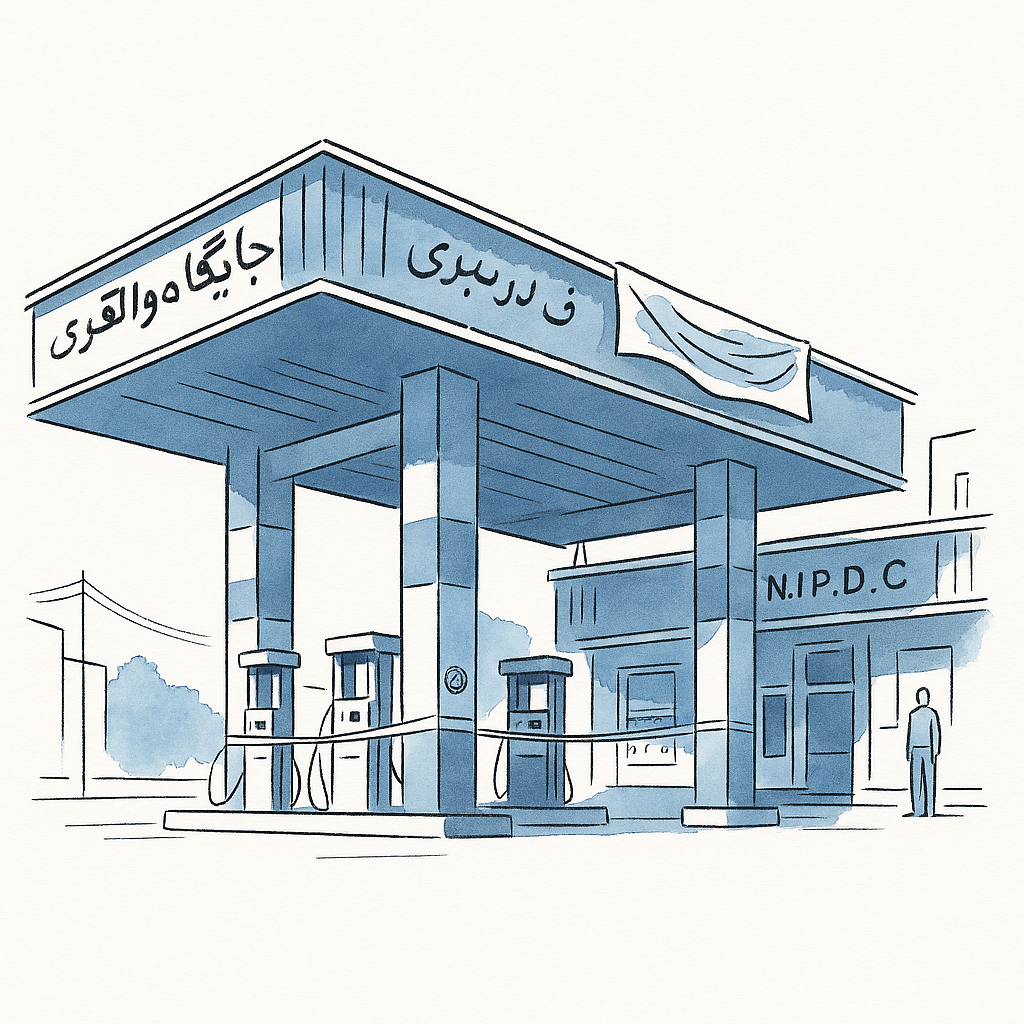
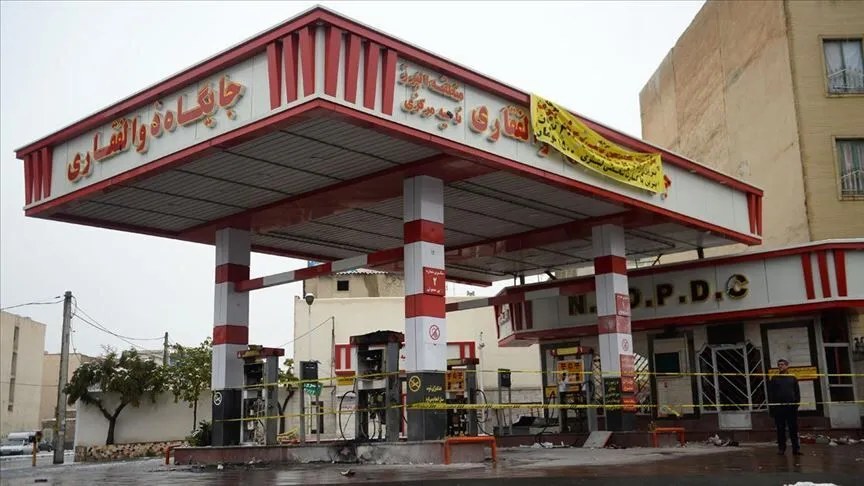
Political time in Iran is not measured by elections. It is measured by queues. Between 13 and 31 August 2026, filling stations in Tehran, Karaj, Mashhad and Kerman saw queues stretch for kilometres, pumps run dry, per-vehicle caps set at twenty litres. State newspapers acknowledged a daily shortfall of around fourteen million litres. On 31 August, the dollar crossed 2.1 million rials on the open market. In that ordinary three-week window, the Islamic Republic put on display seven years of work that few Western observers have yet measured.
It opened on 13 August. Two hundred and four filling stations across Kerman province began selling gasoline at what the government called full refinery cost, eighty-seven thousand two hundred tomans a litre against fifteen hundred tomans for the first subsidised tier. Within hours, the regional director of the National Iranian Oil Products Distribution Company suspended the scheme. On 27 August, the Intelligence Organisation of the Islamic Revolutionary Guard Corps issued an unusual statement that classified livelihood protest, in advance, inside the adversary's declared lines of effort. On the evening of 28 August, President Masoud Pezeshkian announced a targeted rise on the above-quota tier, without setting a date, framing the figure as an example, and referring implementation to coordination with parliament and the judiciary.
Three techniques structure this way of doing things, and they deserve to be named. Tier fragmentation, introduced in December 2025, replaced the single administered price with a three-band structure that reaches each household only at different points in the month. Territorial fragmentation, tested in Kerman on 13 August, allows a region's tolerance threshold to be measured without committing the whole country to the same act. Undated pre-announcement, as practised by Pezeshkian, dilutes the moment of the rise into an interinstitutional coordination process. The subsidy is not being withdrawn. What is being withdrawn is the author of the withdrawal.
This engineering has a father. It is called November 2019, the night the Islamic Republic doubled the price of gasoline by surprise and saw, within seventy-two hours, the opening of one of the fastest waves of contestation since 1979. Amnesty International documented three hundred and four deaths, most from shots to the head or torso; Tehran acknowledged two hundred and thirty in June 2020. The lesson the regime drew from November 2019 concerned neither the size of the rise nor the necessity of household compensation. It concerned the shape of the decision. The protocol ever since has been to strip from any rise the three properties that triggered the uprising: simultaneity, date, author.
That method has a ceiling, and it has just met it. A queue cannot be fragmented. It is simultaneous by nature, public, visible, geographically concentrated, physically collective, and its own anticipation, through precautionary buying, amplifies it. The queue possesses, in short, precisely the properties the regime has spent seven years stripping from the price. Daily distribution running roughly thirty percent above normal since 24 August is the measure of that loop. What the regime built against November 2019 has no purchase on the physical absence of gasoline in the tanks of Tehran, Karaj and Mashhad. The Islamic Republic has solved the problem of 2019 and inherited the problem of June 2007, the month Ahmadinejad's improvised rationing produced a riot without a single price moving.
Even so, what Tehran has built since 2019 must be noted, because it weighs on the current calculation. The internet cut has become graduated, selective, regionally targetable; the noisy, improvised national cut of 2019 no longer applies. The June 2025 espionage law, applied at scale since 28 February 2026, widened the perimeter of capital offences to ordinary acts of connectivity, including the transmission of geolocated images. The 27 August statement classified livelihood protest inside the category of foreign operations before the protest had even formed. An apparatus that files a grievance in advance no longer has to improvise its justification. The penal management of a reaction is prepared before the reaction itself.
This is where the sequence of August 2026 becomes a confession. A state that must dedicate seven years of institutional engineering to erasing the author of a price-hike decision, a state that invests in intelligence, in digital shutdowns and in criminal law well before it invests in the substance of its citizens' lives, a state that organises itself to classify the fatigue of its people, in advance, as a foreign operation, is a state that has abandoned the positive project of government. What remains is a security apparatus organised around a shrinking rent, whose residual function consists in managing the reactions to its own productive incapacity.
That productive incapacity is measured by the regime's own figures. A daily deficit of fourteen to fifteen million litres. Six billion dollars of imported gasoline in one year, in a country holding the world's third-largest proven crude reserves. A monthly average wage of two hundred to two hundred and fifty million rials worth, at the 31 August rate, between ninety-five and one hundred and nineteen dollars. The line between what the Islamic Republic can still hide and what it can no longer hide now runs through the queue at the filling station. What the queue says about the regime, it says without decree, without megaphone, without signature. And in its own way, it is the last entity left in Iran that the regime has no means of fragmenting.